



> Interviews
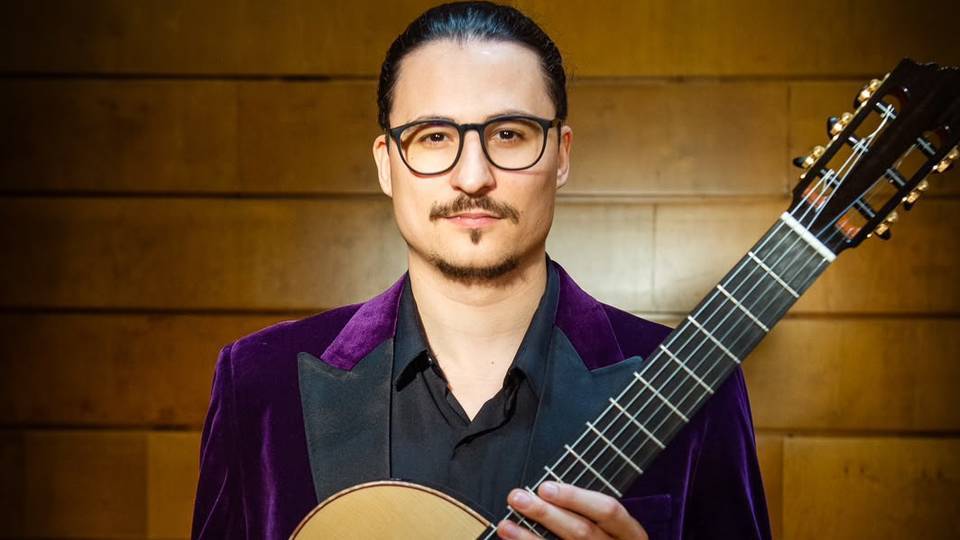
Interview with guitarist Dragoș Ilie on the November 11th “Heirs of Musical Romania” Concert at Sala Radio
You'll be able to watch guitarist Dragoș perform as a soloist in the company of the Radio Chamber Orchestra, conducted by Christian Câșleanu, during the special event-concert on Wednesday, November 11th, 2026. Alongside Dragoș Ilie, a former recipient of the "Heirs of Musical Romania" scholarship, cellist Sofia Blându-the 2025 scholarship winner-and pianist Dominik Ilisz, also a former fellow of the program, will take the stage. In an interview with Ioana Țintea, guitarist Dragoș Ilie spoke about returning to the Sala Radio stage, as well as the importance of the "Heirs of Musical Romania" program, and his artistic journey.
Dragoș Ilie, to start our dialogue, I would like to return to the beginnings of your artistic path. After graduating from high school, you made the decision to continue your musical studies in the United States. What did this change of environment mean to you? How did you experience encountering a new educational system, and to what extent did it influence your professional and artistic development?
To say it was a shock would be an understatement. I don't think I even realized the magnitude of the change that was about to happen once I left for the United States. But it was a remarkable experience. I lived 10 years of my life there-years that changed me tremendously and opened me up a great deal.
I think one of the most important lessons I learned in the United States was to be very open to new people, new experiences, and, why not, novel projects.
Returning to the concert at Sala Radio on November 11, you have chosen two concertos by Antonio Vivaldi: the Concerto in C major, RV 425, originally written for mandolin, and the Concerto in D major, RV 93, originally for Baroque lute. What attracts you in particular to this composer's music, and what are the main technical and expressive challenges involved in adapting these scores for guitar and orchestra?
Vivaldi is one of my favorite composers, perhaps for the simple fact that his enthusiasm is so contagious, not just for us listeners, but also for the great composers of his time, Bach himself considered him a paramount composer.
The two concertos I chose were indeed written for distant relatives of the guitar. In fact, the guitar didn't even exist in its current form back then, yet these two concertos fit, I would say, like a glove on the modern guitar.
When we talk about the mandolin, the Baroque mandolin is actually very similar to the lute. It is almost a miniature lute, and the lute is a direct ancestor of the guitar, so the sonorities of the Baroque mandolin and the classical guitar are very similar.
I found it interesting that the Concerto in C major was written in the very same year as the famous Four Seasons, most likely for the students of the orphanage-the so-called first conservatories in the world. Meanwhile, the Concerto in D major is almost a standard; it has come to be associated with the classical guitar perhaps even more than with the lute. And I learned quite recently that he wrote it In the 30s of the 18th century, back when he was in Bohemia, when he was visiting the Czech Republic of today. It is a concerto full of exuberance and dynamism, very open, offering a lot of freedom to the performer to improvise, as well as to the accompanying orchestra and the basso continuo to play around. I believe that every time these concertos are played, they are actually a new concerto. I am very curious to see how I will play it together with my colleagues from the Radio.
The November 11th concert at Sala Radio is part of the "Heirs of Musical Romania" series, a project initiated by Radio România Muzical. Moreover, you are a laureate of the 2021 edition of the "Heirs of Musical Romania" Scholarship. What was your motivation for applying for this scholarship?
The motivation was very simple. My desire to return to Romanian stages. I applied for this scholarship back when I was still a student in the United States, and I am very grateful, first and foremost, that this scholarship exists, because it offers young Romanians an extraordinary opportunity to reconnect with their country and its stages through the projects they submit.
For me, it was a blessing and helped me enormously. In fact, it truly laid the foundation stones for my return home, and I am especially grateful to Cristina Comandașu and the Rotary Club Pipera for keeping this project alive.
With what thoughts do you await your reunion with the Sala Radio audience?
To be honest, with nerves. The nerves will never leave me, but at the same time, I look forward to it with the hope that the audience will enjoy these concertos-this music that I dare to call novel and remarkably alive 300 years after it was written.
What are the directions and projects you have in mind for the immediate and medium-term future?
I am planning to record an album of solo works. Although I am not the biggest fan of recording, I think the time has come for me to step back into my personal laboratory of experiments. I cannot reveal the theme of the repertoire yet, but it is something very close to my soul.
At the same time, I have a series of concerts lined up with violinist Alexandru Tomescu for this year, and a mini-tour with the Romanian Guitar Quartet, a newly formed ensemble. This year, we delighted audiences with Vivaldi's famous Four Seasons arranged for four guitars. I also have a special concert in December alongside cellist Sofia Blându-who is also a featured soloist in Wednesday's concert-and Maestro Alexandru Tomescu. We will perform a series of new works written by composer Dan Popescu alongside other pieces from the classical repertoire.
And who knows what other whimsical projects might be on the horizon.
Photo credit: Ioana Chiriță
Translated by Mara Puiu,
University of Bucharest, Faculty of Foreign Languages and Literatures, MTTLC, year I
Corrected by Silvia Petrescu


