



> Interviews
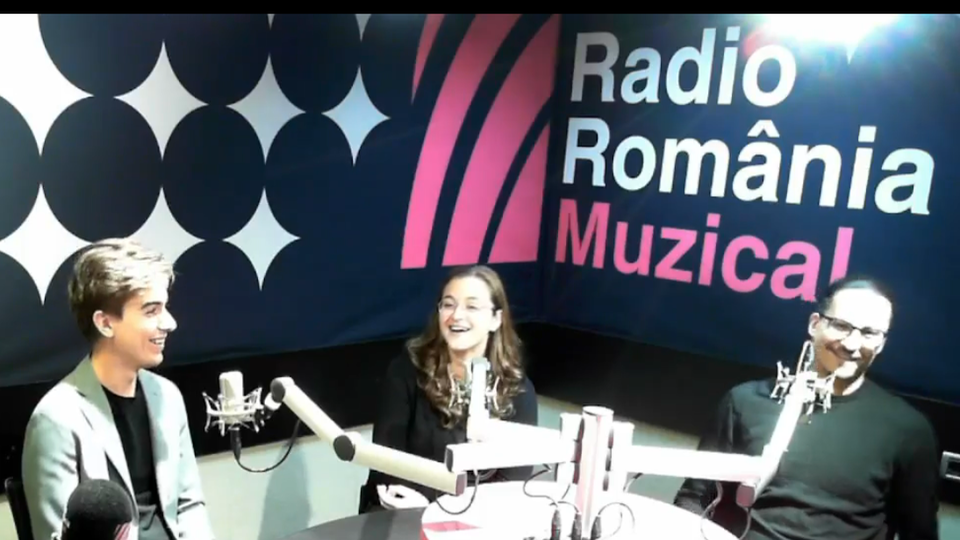
Interview with guitarist Dragoș Ilie, cellist Sofia Blându, and pianist Dominik Ilisz
Tomorrow, November 11th, a concert featuring three concertos will take place at the Radio Hall, starring three young Romanian musicians who are scholarship recipients of the Heirs of Musical Romania programme, organised by our radio station with the support of Rotary Club Pipera. The three musicians are guitarist Dragoș Ilie, cellist Sofia Blându, and pianist Dominik Ilisz. The Radio Chamber Orchestra will be conducted by Christian Câșleanu. All three soloists are here with me in the Radio România Muzical studio.
Good evening!
Hello.
Good evening.
I'd like to start by asking you a few questions about the rehearsals, since, as I mentioned, the concert will take place tomorrow evening. The rehearsals have already begun. How have they gone so far? Dominik?
I've really enjoyed working with the orchestra, and especially with the conductor. We'll be performing Mozart's Piano Concerto No. 23 in A major, and I'm already really looking forward to the concert.
Sofia?
I started rehearsing today. The atmosphere was wonderful. The Radio Chamber Orchestra is very flexible and accommodating, and it's a real pleasure to perform Joseph Haydn's famous Cello Concerto in C major, together with conductor Christian Câșleanu.
Dragoș?
We had a lot of fun today because we made a few adjustments following yesterday's rehearsal. I'll be performing two concertos by Antonio Vivaldi, originally written for mandolin and lute. We'll also have a harpsichord and basso continuo, so today we experimented with the placement of the instrument, moving it a little closer to me so that we could interact more easily. I think it turned out really well. Honestly, I can't wait for tomorrow.
We can't wait to hear you perform,too. I'd like to know how you came to choose these particular works and how you decided which concertos you would perform. Dominik?
I've always loved Mozart's Piano Concerto in A major. I think it was the first concerto I ever heard at the Musikverein in Vienna, when I arrived there as a student. It made a huge impression on me from the very beginning, and ever since then I've always wanted to have the opportunity to stand in front of an orchestra and perform it myself.
What was it that impressed you in particular?
The second movement, especially, made a very strong impression on me. It's quite unusual for Mozart to be so simple and sincere, yet at the same time so deeply sad. I really loved the atmosphere that the piano and orchestra are able to create together.
When Mozart is in a melancholic mood, his music is very lyrical and deeply moving. All right, Sofia?
I chose this concerto partly because it was one of the first concertos I studied, first in Iași and later in Bucharest. It certainly has its virtuosic moments, but it also has a great deal of sincerity, just as you mentioned in connection with Mozart's concerto. There is a sense of expansiveness, a wonderful variety of colours, and, of course, the opportunity to collaborate in a chamber music style with the Radio Chamber Orchestra. I think it was a very good choice for tomorrow's concert.
Dragoș?
I've wanted to perform these two concertos for a very long time. They are standard works in the guitar repertoire. In fact, I would say that the Concerto in D major, RV 93, is more closely associated with the guitar than with the lute. I wanted to perform something I hadn't played in quite a while. I know these concertos very well: I've taught them, studied them, worked on them, and analysed them in great detail. But stepping into the role of soloist changed the whole game. The confidence I had at the beginning completely collapsed, and I had to start from scratch. It turned out to be quite an exciting experience, I think. I learned quite a lot along the way. And, as Sofia was saying, it's so… For me, as someone who isn't an orchestral instrument, it's quite a shock to hear so many beautiful instruments around me, all working together with me. I'm so used to playing on my own, perhaps accompanied by one or two instrumentalists, but not with an entire orchestra and a harpsichord alongside me.
I'd like us to talk a little about this. How do you actually prepare yourselves for working with an orchestra? This time, we'll start directly with Dragoș and then come back to the others.
When it comes to working with an orchestra, two words: pray and play. I think listening to lots of recordings helps, and of course, practising along with recordings. I'm not sure what else I could add. I'm the least experienced member of this trio when it comes to performing with orchestras, but I do think listening to recordings is very helpful.
Sofia?
For me, this is something I learned later on: I study the full score. First of all, I need to know exactly what the orchestra is playing. I can even say that, from time to time, I imagine myself conducting the concerto. And, of course, there are many occasions when Haydn's concertos are performed in a play-and-conduct format, which means that I need to know the orchestral parts very well.
And you, Dominik?
I also rely a lot on recordings, which really help us form an idea of what the concerto will sound like in the end. Another thing that helps is playing together with my teacher, who sits at a second piano and plays the orchestral part while I play the solo part.
And speaking of the recordings we mentioned earlier, how do you choose which ones to listen to? I imagine that finding your own interpretation, your own voice, is not an easy journey. I'd really like to know-and I'm sure our listeners are curious too-how does a young musician find their own path and put their personal stamp on a piece?After all, the works you are performing are major works, well-known pieces that have benefited from dozens, if not hundreds or even thousands of interpretations. How do you make these works your own? How do you make them bear your signature, so to speak?
I think every performance is different anyway. Personally, I like to listen to as many recordings as possible, so I can get the clearest possible picture of the piece. But once I'm on stage, the interpretation will inevitably be something very subjective.
Sofia?
Over time, I've tried to distance myself a little from recordings in general. Of course, I rely on my own instincts-instincts that I'm constantly developing and refining. I also make extensive use of theoretical knowledge, whether it's harmony, music history or the history of the particular concerto. I try to bring together my musical instinct, my education and all these other elements to shape my own interpretation.
Dragoș?
I'll speak specifically about Vivaldi, because this was something I struggled with. I found it very difficult to listen to guitar recordings, because guitarists tend to play the piece in a very guitaristic way-not to offend any of my fellow guitarists, but even the great ones approach it from a very guitar-oriented perspective. But this concerto wasn't originally conceived for the guitar, since the instrument didn't even exist in its present form at the time. So, in order to really fill my ears with the right kind of sounds, I listened to other works by Vivaldi, as well as pieces by Corelli and Telemann, exploring the concerto genre-not necessarily just instrumental concertos, but even Concerto Grossos-so I could absorb their approach to articulation and sound. After that, I played a little with the mandolin and the lute, just enough to capture some of that instrumental atmosphere… I m not quite sure how to put it into words, but that was my approach to this particular concert.
I think that was a very good way of putting it: 'to capture that atmosphere.' I'd like us to talk a little about this kind of contextualisation, both from a historical perspective and in terms of interdisciplinarity-if we want to use a more academic term-drawing on music history, harmony and all these related fields. Why are these aspects important? Why should a young musician have a good understanding of them? I don't know if you've had the same experience, but I certainly have had colleagues and students say things like, 'Why do I need to study harmony? Why do I need music history?' And I'm curious to hear how you would respond to young musicians who think this way. Dragoș?
I'm going to put on my professor's hat for a moment, because I often find myself in this position with my students at the Conservatory in Iași, where I teach. I think the point is that every musician needs to understand that we are, in a way, time travellers and storytellers. To tell a story, it's not enough simply to narrate the events. You also need to establish the setting. If you don't understand the atmosphere Vivaldi breathed, the streets he walked, if you don't have a sense of Venice as a city and as a cultural centre, or understand the importance of the violin as a solo instrument during that period, then yes, you can play all those notes, but you won't be able to convey the story with the same conviction as a really good storyteller. And a wonderful example of such a storyteller is Maestro Celibidache: You know, when someone tells a story like that, they take you to twenty thousand different places. They paint the whole picture, every little detail, and yet all they're talking about is polenta with cheese! That's exactly how I see it, and it really works. When I explain this to my students, they begin to understand that it's not just about the notes. And that's when I can subtly slip in a little harmony and music theory along the way, almost without them noticing, so they realise it's not just about what they learn in the classroom.
Sofia: Yes, absolutely. I agree with you. Of course, every time I open a new score, I'm not quite sure where to begin or how to approach it. That's why it's so important, as a musician and as an artist in general, to have a very clear understanding and structure of the piece you are about to perform.
Dominik: I also agree with everything that has been said so far. I believe it really helps us learn a piece when we understand exactly what we're doing, when we know the harmony and understand how everything written in the score works.
And speaking of opportunities that could be valuable for young musicians, let's talk about these scholarships, which are, in fact, what brought you here in the first place.I'd like to hear about your individual experiences with the scholarships and how you view this initiative. Sofia, let's start with you.
First of all, I have to express my gratitude, and I think we all do, to Mrs. Cristina Comandașu and to Rotary Club Pipera for this initiative. If I'm not mistaken, I believe this is one of the largest scholarships of its kind in Romania. I was the winner of the 2025 edition, and it has given me the freedom to take part in various masterclasses, which are not inexpensive. It has also given me the opportunity to start thinking about purchasing a bow in the future.
Dominik: I actually had the opportunity to perform and receive the scholarship for the first time back in 2022, if I remember correctly, when I performed in both Brașov and Bucharest, including a concert here at Sala Radio. I played Beethoven's Piano Concerto No. 3, and I remember it being an incredible opportunity. It still is today, of course, but for a student to have the chance to perform with some of the finest orchestras in the country was truly something very special.
I remember that concert too. We still have the recording, and it was a wonderful performance. Dragoș?
Oh my goodness, I don't even know where to begin! For me, this scholarship marked so many beginnings. First of all, it made my debut album possible, which I recorded right here at Casa Radio. It also gave me the opportunity to make my debut with the Radio Orchestra, performing the Concierto de Aranjuez. And my debut with the Transylvania Philharmonic Orchestra in Cluj was also made possible through this scholarship. I also had the opportunity to meet Alexandru Tomescu, with whom I went on tour the following year, and again two years later. In a way, this scholarship was also a cornerstone in my decision to return home permanently from the United States, where I was pursuing my doctorate-or, actually, I'm not even sure I had started it yet! It was 2021, and I was still a student in the US. So, yes, the scholarship really brought me back home…..It brought me home. It showed me that there is a wonderful audience here in Romania, one that wants to connect with our music. And, well, the rest is history.
And finally, would you recommend this path to young musicians?
Absolutely!
With all our hearts.
Then I'd like to ask at least one of you, if you could, to invite the audience to tomorrow's concert.
Sofia: Dragoș, you spoke so beautifully!
Dragoș
I would be absolutely delighted to see you there! It's not every day that you get to experience a Concert of Concerts. There will be four concertos for solo instruments and orchestra, and I'll be sharing the stage with some fantastic young colleagues.
I think we're going to have an enormous amount of fun! You'll get to hear a spinet, music by Haydn and Mozart, and some very interesting encores as well. I've seen what's been planned in our group chat, but I can't give away any spoilers! So, that's all I'll say for now. I look forward to seeing you at the concert!
Thank you very much for joining us in the Radio România Muzical studio. We look forward to hearing you tomorrow evening, live from Sala Radio.
Translated by Ruxandra-Ioana Șerban,
University of Bucharest, Faculty of Foreign Languages and Literatures, MTTLC, year II
Corrected by Silvia Petrescu


