



> Interviews
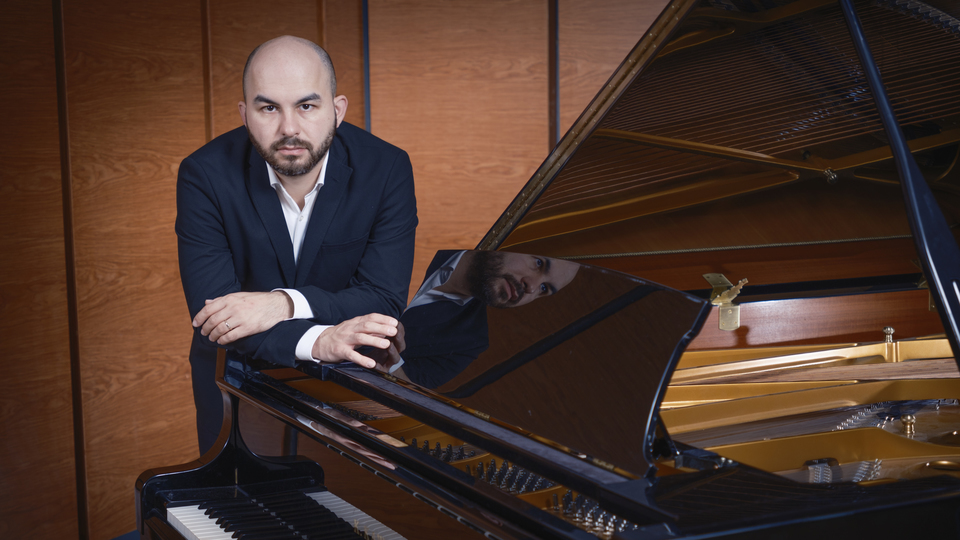
Interview with pianist Ioan-Dragoș Dimitriu regarding the concert at Sala Radio on November 28th
On November 28th, Sala Radio will host the "Vienna X Gershwin" concert, an event presented by pianist Ioan-Dragoș Dimitriu and the Vienna Chamber Orchestra. The program features Ludwig van Beethoven's Piano Concerto No. 1 in C major, Op. 15, alongside five works by George Gershwin's "Songbook" for solo piano and his Piano Concerto in F major.
This event also marks the return of the Bösendorfer Imperial piano at Sala Radio to active use.
Tickets are available via the bilete.ro site.
Ioan-Dragoș Dimitriu, one of the project's initiators, spoke to us about the concert:
On November 28th, you are presenting a unique concert to the audience at Sala Radio. Let's start with the program. Together with the Vienna Chamber Orchestra, you are bringing two musical worlds into dialogue - those of Ludwig van Beethoven and George Gershwin. How did you choose these two composers, and how do you envision their encounter unfolding?
The program actually tells my own story, because Beethoven was the first great classical composer I studied in depth; he instilled in me a certain discipline and rigor, while also revealing a great sense of humor. He was a figure who, in his time, completely broke the mold.
Same goes for Gershwin, which is why I paired them together. Gershwin was one of the first to take dance music, if you will, from the neighborhoods and the streets and bring it into the realm of major concert halls. That is why I felt there was a very strong affinity between these two composers.
On another note, Gershwin has always had the power to make me feel good, or to lift my spirits. For instance, if I were ever suffering from a bad cold, putting on Gershwin's "Rhapsody in Blue" would suddenly make me feel much better. In a way, he taught me to take things in stride and to be more relaxed in life.
The "Vienna X Gershwin" concert on November 28th also marks the return to active use of the Bösendorfer Imperial piano at Sala Radio. What is the story behind this instrument, and what do you hope for its future?
I was aware that this piano existed at Sala Radio. It remained in working order, kept in a studio where it was used for rehearsals, recordings, and so on. However, for perhaps the last 15 years, it lacked regular maintenance. Pianos typically require servicing once a year, or ideally, every six months. I know that in Romania, a lack of funding often leads to this situation, where pianos end up being somewhat neglected from time to time. But now, given this opportunity, with the Vienna Chamber Orchestra also joining, I felt it created a special Viennese setting, and the Austrian Embassy also joined the project.
So, I reached out to the Bösendorfer piano factory in Vienna, explained the whole context, and they agreed to carry out the servicing, essentially restoring the piano to the same technical condition as if it had just left the factory and ensuring it reached the highest possible technical standard.
And what I wish for is that as many musicians as possible can benefit from this piano over the next 10, 20, or 30 years. It is a very, very valuable instrument, as it is no longer mass-produced, but rather only crafted for specific, special orders, and its price is extremely high because it has become a sought-after item among collectors. By restoring it, we are ensuring its longevity and a much longer lifespan.
This year, the Vienna Chamber Orchestra celebrates eight decades of activity. With the concert in Bucharest on November 28th, you, too, are part of this anniversary. What connects you to this ensemble, and what connects you to Vienna?
I lived in Vienna for nearly 13 or 14 years, and I completed my studies there. At one point, I was desperately looking for a job, so I reached out to the manager of the Vienna Chamber Orchestra, Christian Buchmann. After a conversation that lasted about two hours, he told me, "I don't want you to be my employee; I want us to become partners and create projects together." That is exactly what happened years later, and I finally understood why he hadn't hired me for that position back then. Indeed, we have been collaborating very successfully for several years now.
The Vienna Chamber Orchestra has previously visited Bucharest in 2009 and 2021 for the George Enescu Festival. Now, marking their 80th anniversary, it felt like the perfect moment for them to return to Bucharest, albeit in a smaller ensemble. In fact, if you visit their website, you will see them listed as "Soloists of the Vienna Chamber Orchestra". Some of their finest members - essentially, their section principals - will be joining me. There will be 10 musicians taking the stage alongside me on November 28th.
How has this experience enriched you and what have you learned from the Viennese music scene?
I have been deeply engaged with the Viennese music scene, but also its private sphere, where the tradition of "house concerts", meaning performances held in private homes, still thrives.
Over the years, I have developed a very high level of discipline. I've learned that no two concerts are ever the same, and that unforeseen challenges always arise, but with rigorous preparation, one can overcome any such obstacle.
What I also truly appreciated was that the city itself, quite literally, breathed culture and music. At every turn, you would see people carrying an instrument on their back; and the fact that, during the 13 years I spent there, I had the opportunity to perform in all these concerts, alongside children, perhaps children of the members of the Vienna Philharmonic (there are families involved in the Viennese musical tradition for more than five decades, mainly in the Vienna Chappel Choir and, later, the Vienna Philharmonic) made me feel very small in this world, yet also aware that I had a great deal to learn from those around me.
You are the initiator of this concert taking place on November 28th at the Radio Hall. How was the project conceived?
It all began about two years ago, when I reached out to the Vienna Chamber Orchestra to propose this partnership. Getting a confirmation took quite a while, as their touring schedule is already fully booked for the next 3-4 years. However, this concert would not have been possible without the support of the Radio Romania management, our partners, like BCR, AFI, Regalina, and Brand Office and, of course, our media partners, Radio România Cultural and Radio România Muzical.
Photo credit: Șerban Mestecăneanu
Translated by Narcisa Bleau,
University of Bucharest, Faculty of Foreign Languages and Literatures, MTTLC, year I
Corrected by Silvia Petrescu


