


> Interviews
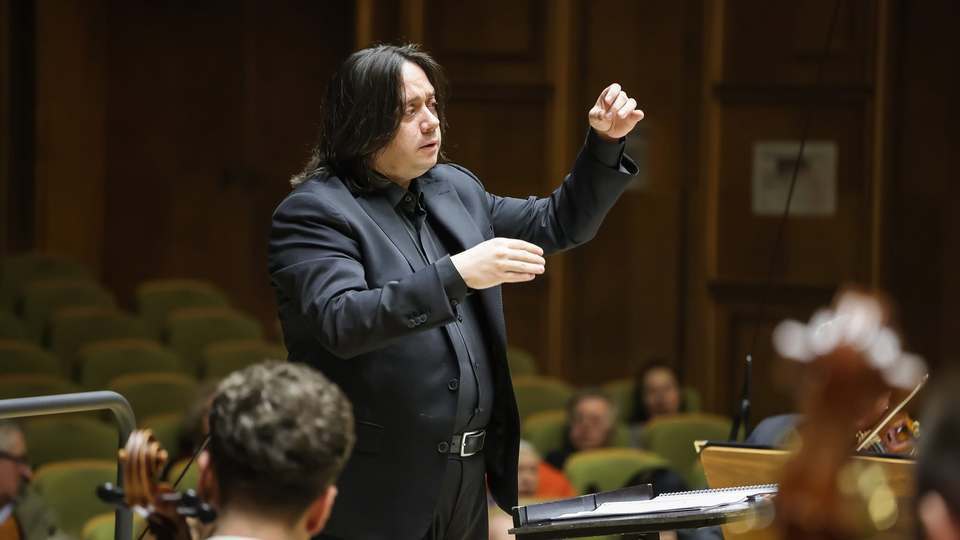
Interview with conductor Gabriel Bebeșelea
This evening, Friday, 13th of November 2026, Radio Hall hosts a concert performed by the National Radio Orchestra, the Radio Academic Choir and the Radio Children's Choir, under the musical direction of conductor Gabriel Bebeșelea. To learn more about the event, we turn to an interview Gabriel Bebeșelea gave to our colleague, Cristina Cîrjan.
Mr. Gabriel Bebeșelea, how have the rehearsals gone so far, and how would you describe this reunion with the National Radio Orchestra and the institution's choral ensembles?
Indeed, during rehearsals this week I realized I hadn't been with the National Radio Orchestra for quite some time. I was glad to reconnect with the many musical friends I have in this orchestra and to immerse ourselves in an absolutely spectacular universe of sound.
George Enescu's Third Symphony is one of the most difficult works in the symphonic genre, or rather the vocal-symphonic genre, since we also have two choirs: the Radio Academic Choir and the Radio Children's Choir. It is an extraordinarily complex language, but one that gives you a great deal of satisfaction if you manage to discover the key in which to read the score.
It is a symphony strongly marked by the First World War, written in Iași, in exile, while Bucharest was occupied. As the well-known music critic Emanuel Ciomac, a close friend of Enescu, said, it is a symphony that must be read through the key of Dante's Divine Comedy. There are three movements. The first actually reflects the Purgatory, the second is the Inferno of War, and the third is Paradise, where the choirs appear.
Therefore, this symphony is a journey, both musically and spiritually. The music is deeply emotional and, for all its complexity, offers a highly rewarding sonic experience.
The concert opens with pages from the work of Richard Wagner: the "Prelude and Liebestod" from Tristan und Isolde and "Good Friday Spell." On one hand, the emotion of impossible love; on the other, hope and peace. What would you like the audience to retain after encountering Wagner's musical world?
Exactly how Enescu's symphony ends: with hope.
In fact, in building this program I started from the following idea. Shortly before Enescu began sketching the Third Symphony, he had conducted the Romanian premiere of Act 3 of "Parsifal" in Bucharest, which contains this fragment, "Good Friday Spell." What's more, in the third movement, at one point Enescu calls for small bells used in the Catholic church at the moment of elevation. That is exactly the indication in the score. At the elevation in the Catholic church, the bread, meaning the body, and the wine, meaning the blood, are lifted and blessed, which is why it's called the elevation. And it is directly connected to the Holy Grail, which is revealed in "Parsifal," a work about the search for the Holy Grail and its discovery. "Good Friday Spell" is this light that spreads from the Holy Grail through the whole universe, just as Enescu's symphony brightens at the end. It closes with an extremely optimistic paradise, after all the vicissitudes of war in the second movement.
Going further back from Parsifal, I connected it with "Tristan und Isolde," because it is one of the works that influenced Enescu the most. He speaks very often about how important this work was for him, and I wanted to show, both to the musicians on stage and to the audience, how strongly these works are connected. Enescu always considered himself a post-Wagnerian, although he was of course strongly influenced by French music and by Romanian folkloric stylemes.
So perhaps the three works are connected both ideationally and sonically.
Enescu's Third Symphony was composed, as you said, during a period marked by the First World War. It is also a score of exceptional complexity. What do you consider the main challenges in approaching such a score?
Usually, not only in the Third Symphony but also in "Oedipe," the hardest thing is to discover the guiding red thread. It is extremely laborious and requires a great deal of energy and time. That includes discussions with the musicians to reveal and reflect not only Enescu's musical ideas, which were extraordinarily clear, but also this complexity, because there are textures that always accompany the main material, yet very often seem more important than the guiding thread itself. From my point of view, this is the greatest challenge of this period of Enescu's composition: discovering the line. Once that line is found, all the materials calibrate themselves.
You are also known for your research work. Does it happen that the information you discover through research fundamentally changes the way you approach a work as a conductor?
Of course. I subscribe to the idea that the performer must always go to the primary source, or as close to the primary source as possible-the first edition, the manuscript, and so on. Sketches, where possible.
For example, in Enescu's Third Symphony itself, in the first edition, from 1965, for it was only 10 years after Enescu's death that this symphony was published for the first time, there is a very "amusing" mistake. There is a small note written for the cello, right in the second measure of the symphony, in the first theme. Looking at the manuscript, I realized that it was actually a "piano" marking. And that the note doesn't exist. That edition was reissued and republished, and so it was played that way for a very long time. And there's something else: in the surviving manuscript, Enescu wrote down a great many conducting indications. There are markings Enescu made when he conducted the premiere of the symphony. There are many instructions on how to beat time and how to subdivide. This not only tells you how Enescu conducted, but lets you get inside the musical construction. You see how he divided the structure, how he subdivided and relaxed the beats. And then you realize that this music requires a great deal of patience when performing it.
I discovered that ten years ago, in November 2016, you were on this very stage at Radio Hall, on the podium of the Radio Chamber Orchestra. At that time, you were already recognized as one of the most talented Romanian conductors of your generation. Can you tell us how your perspective on music, and on the role and purpose of the conductor, has changed over this decade?
I hope things have changed! I like to think I've become even more of a slave to the score, a devotee of the most assiduous, well-defined study possible, with the greatest accumulation of detail from a score. One thing I confess has accompanied and preoccupied me for a very long time, for example with this very Enescu symphony, since it's not the first time I've conducted it, is that every time I return to a work I have a new score. The reason is that I discover paths I had noticed but perhaps hadn't given as much importance to, or I discover details that, in a certain interpretive key, take on meanings I wouldn't have thought of before.
I think this is the main thing that has changed in the last 10 years, as a general rule: using a new score every time I conduct a work, even one I've conducted many times.
Translated by Gabriela Mara Puiu,
University of Bucharest, Faculty of Foreign Languages and Literatures, MTTLC, year I
Corrected by Silvia Petrescu


