


> Interviews
Interview with conductor Kaspar Zehnder
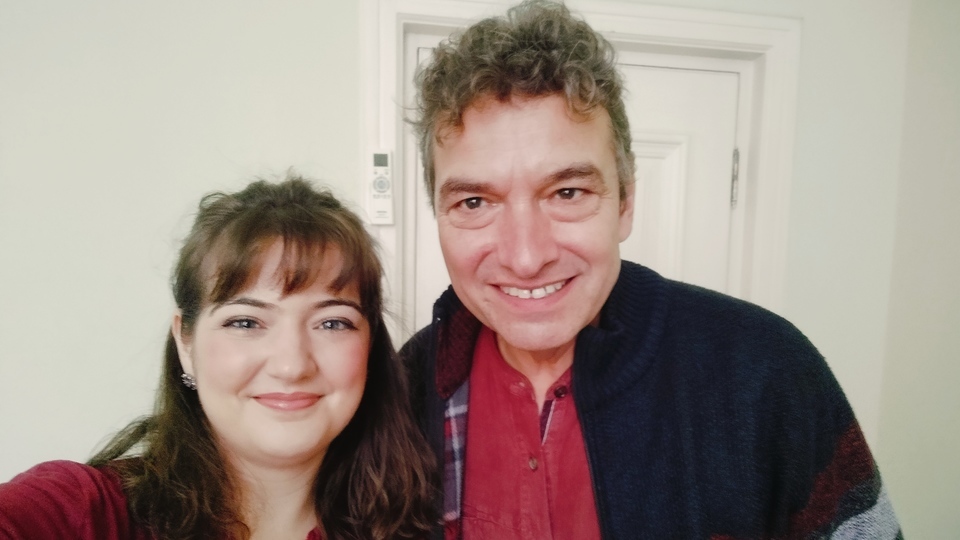
Conductor Kaspar Zehnder will conduct the George Enescu Philharmonic Orchestra in concerts taking place on November 12th and 13th, 2026 at the Romanian Athenaeum. The programme features works by Myriam Marbé, Pyotr Ilyich Tchaikovsky and Paul Hindemith, featuring cellist Aurelian Pascal as the soloist. Ana Sireteanu spoke with Swiss conductor Kaspar Zehnder, who was kind enough to hold a discussion in Romanian regarding the program for the concerts at the Romanian Athenaeum.
Mr. Kaspar Zehnder, you are returning to Romania; you have previously conducted the National Radio Orchestra, and now you will lead the Bucharest Philharmonic Orchestra.
I have never been to the Enescu Philharmonic. This will be my first time on the stage of the Athenaeum, though I have been there as a member of the audience. It is a fantastic, truly beautiful hall! I have frequently attended concerts at the Radio Hall and with the Radio Chamber Orchestra. I have also worked extensively with orchestras in Transylvania and Timișoara.
There is a lovely atmosphere here, the people are kind, and for me, it feels like a breath of fresh air. We Swiss tend to be a bit formal, but in Romania, I feel completely unconstrained, and I really enjoy it!
What about the audience?
I think the audience in Bucharest is welcoming, very educated, and cultured, much like in Germany, where people are showing a very big interest in music. In France or Japan, the audience is enthusiastic, but they lack this level of education.
You will be performing a work by Myriam Marbé. Could you tell us how you would describe Serenata - Eine Kleine Sonnenmusik?
In fact, I first conducted Serenata - Eine Kleine Sonnenmusik, translated as "A Little Sun Music", in 2003. At one point, there is a reference to a motif from Mozart's Eine Kleine Nachtmusik ("A Little Night Music"). It is, indeed, avant-garde music for 1974. It is aleatoric music, which means I am not conducting the entire time. Instead, I provide specific cues. For instance, indicating "number 1" or "number 2", while the orchestra plays various motifs that each musician interprets as they wish, according to their own feeling within the context. It is truly beautiful because the music is so spontaneous. There are also percussion instruments, children's instruments, actually, such as a ratchet, bells, or a water-whistle, making it all very lovely, like a kind of game.
I believe that for the audience, too, this will be something entirely new and spontaneous! There will be instrumentalists performing from within the auditorium. We have five violins and two flutes, and one of the flutists also plays the "toacă" (a traditional wooden percussion instrument used in monasteries). It instantly evokes a spiritual atmosphere, reminiscent of a Sunday service or a church liturgy, and I find this music to be deeply inspired and full of spirit. I really love it.
I discocered this work by coincidence; when I married my wife, who is from Bistrița, în Romania, I wanted to put together a program with a Romanian flavor for my orchestra în Bern, Switzerland. We performed Enescu's Chamber Symphony, among other pieces, and I also wanted to include a work by a female Romanian composer. Someone suggested this particular piece - which is scored for a chamber orchestra (we didn't have a full-sized orchestra available for that project), and it turned out to be ideal. I performed it with my students, and they found it very engaging because each musician gets the chance to step into the role of a soloist for a brief momement; I believe it is a true pleasure for every musician to perform this music.
So you performed it a few years ago with that orchestra?
Yes, in 2003, when I received the invitation to conduct in Bucharest, I thought of presenting this work. Perhaps the audience isn't familiar with it, and it will be interesting!
You will also perform Paul Hindemith's Mathis der Maler Symphony. How would you describe the way the composer treats the story of the painter Grünewald?
I believe the primary reference is Renaissance music. There are three or four moments where a Catholic church chorale is clearly audible. It is not harmonized, it consists solely of unison, much like a Gregorian chant, and it is truly beautiful; this material transforms the entire musical fabric, imbuing it with great expressiveness. The painter Mathias Grünewald, who created this triptych in Colmar, the Isenheim Altarpiece, focused on the Nativity, the Death, and the Resurrection of Christ; it is a profoundly expressive work. It does not follow the Baroque style one might expect; rather, it feels remarkably modern to us. I believe Hindemith's musical language, which draws upon a deeply studied craft (reminiscent of Bach or Schumann), remains exceptionally clear.
You are a flautist, you frequently perform chamber music, you have held the position of principal conductor with major ensembles such as the Prague Philharmonic, and you are also the director of the "Murten Classics" festival; I was wondering how these various facets of your work come together, and how conducting and performing influence one another?
I have never been interested in a one-dimensional career. I have always been keen on working with people, with musicians, and I have always enjoyed chamber music. To me, an orchestra is essentially large-scale chamber music. I believe the best conductor is one who "organizes the music" to the point where the orchestra begins to play on its own, intuitively grasping what is essential and what needs to be brought to the fore-naturally giving the music greater depth and relief.
Naturally, the dramaturgy of a festival has always fascinated me-exploring the connections between art, literature, and music. These are themes drawn from life that make for a compelling program.
To return to our program: all the works featured were inspired by something. Tchaikovsky drew inspiration from a Rococo theme, a style characteristic of the era of Haydn or Carl Philipp Emanuel Bach, thereby capturing the spirit of that period in his music. The same applies to Hindemith: upon encountering a painting by Matthias Grünewald, a work that is both spiritual and expressionistic, he crafted music to reflect this source of inspiration. He first composed a symphony, and then, a decade after its premiere, he wrote an opera based on the same subject matter. The symphony came first, followed by the opera. As for Myriam Marbé, she drew a touch of inspiration from Mozart, there is a brief moment toward the end where the celesta plays Papageno's theme from The Magic Flute. It is a magical moment. Ultimately, each composer creates music that is authentic, yet rooted in references to the past, elements that remain an integral part of our lives.
All composers-no matter how modern or innovative they may seem today-are, in fact, all rooted in what has come before in the history of music.
Exactly. That gives me great pleasure, because it's clear that we're on the same "train."
Of history, in fact.
Exactly.
I also wanted to ask you about the soloist-have you performed with Aurélian Pascal before?
Yes, I know the soloist. We haven't performed together, but we've known each other for a long time. He belongs to a new generation of musicians from France. I believe he will become one of the most significant soloists, not just in France, but globally, as he is a highly talented cellist. Last year, he performed with my orchestra in the Czech Republic, playing Dutilleux's Tout un monde lointain, arguably the most important 20th-century French concerto for cello and orchestra. We stayed in touch after that performance, and now, for the first time, we are working together. I am very pleased about this!
Translated by Ioana-Cristina Bolbose,
University of Bucharest, Faculty of Foreign Languages and Literatures, MTTLC, year I
Corrected by Silvia Petrescu


