



> Interviews
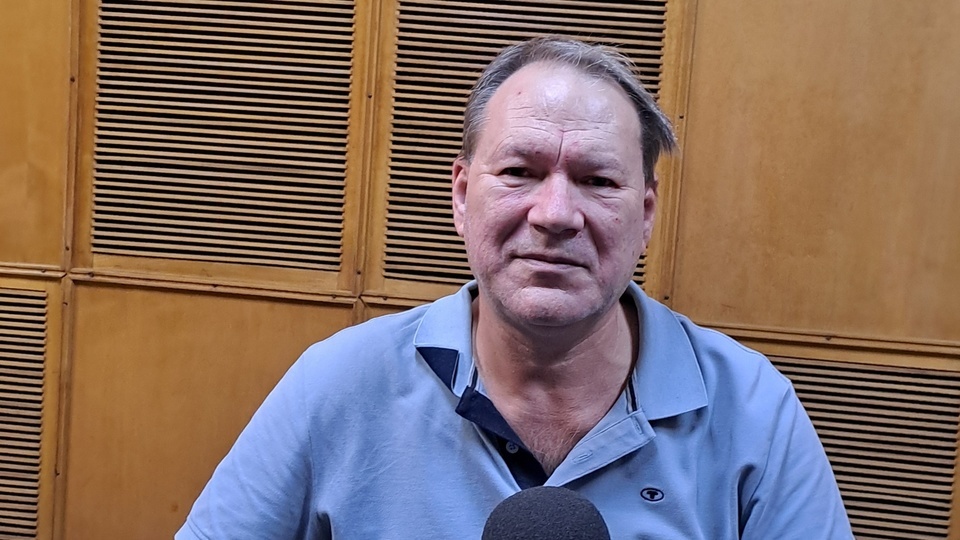
Interview with Liviu Ofițeru, conductor of the Radio Boys’ Choir
The Radio Boys' Choir will give a new concert this Tuesday, November 17th 2026, on the Sala Radio stage, entitled "Viva la musica". Ioana Țintea spoke about this event with Liviu Ofițeru, the conductor of the ensemble, who is also behind the concept, choreography and stage direction of the show.
Liviu Ofițeru, how did the idea for this concert come about and what does the title Viva la musica mean to you?
The idea for this concert was born through extensive research into the Baroque, Renaissance and even earlier medieval repertoires. We have here a diptych made up of two songs, O virtus sapientiae by Hildegard von Bingen and Caritas abundat in omnia. They will be sung by a soloist, a sopranino, who's a member of our choir, Șerban Șușnea, who will also play the recorders, two at once - that will be a surprise. There is a little staging at play here, after the children enter the hall to music by Michael Praetorius, a very old canon, Viva la musica. Hence the title of the concert.
And we are delighted that among our guest collaborators for this concert we have the principal cellist, section leader of the National Orchestra, Florin Mitrea, who is also the founder of the Musica Viva ensemble. We also have Fernanda Romila on spinet and Dan Racoveanu on organ, as guest performers.
This is not only the Boys' Choir's concert; it is also a concert for instrumental music. There are moments when the choir will not sing; there will be an instrumental ensemble made up of myself on violin and the leader of the ensemble, Andi Ancuceanu, who is a member of the Children's Choir and section leader in the Boys' Choir, as second violinist, Florin Mitrea and Fernanda Romila on continuo. Maestro Dan Racoveanu will accompany us on organ for several pieces, and we have percussionists from the choir.
I don't want to completely spoil the surprise, but I can tell you that the beginning of it will be special, since Hildegard von Bingen's music, written almost 900 years ago, will transport us centuries back.
It will be an interesting visual experience; we hope you will enjoy it.
The first part of our concert is structured around religious music, and after the interval we approach the secular music repertoire.
I would like to mention, among the pieces in the second part, a piece by Henry Purcell in Ioan Dobrinescu's arrangement, in its absolute premiere, an arrangement of "Music for a While" for seven voices. The concert will end with a triptych by Constantin Râpă, Codex Caioni, after Ion Căianu, and with "Paikos Tanz" in Magdalena Faur's arrangement.
I would also like to mention that Magdalena Faur is a guest conductor, present in the second part of the concert for several pieces, especially since she is the founder of this ensemble, as she came up with the idea of forming a boys' ensemble of the Children's Choir, which afterwards, in 2024, formed the structure of the Radio Boys' Choir. We are currently in our third season.
What role does music play in the training and education of these 30 young people who make up the Radio Boys' Choir?
Good question! This question has been asked before, and I hope it reaches as many people as possible.
It is very good that parents guide their children towards sports, towards movement; not just sitting in front of screens, but also having physical activity; sport is a very good thing.
Beyond the importance of music education, choral education has a distinct component; it is a special education, it is the place where children come and learn. They like to sing and they can do it well, and they do it with great pleasure, but in the choir they receive a special type of education in the sense of building a team. Choral education is similar - somewhere I will draw a parallel also from sport, with rugby. Rugby is a team sport played by 15 players who work together toward a goal. Football is too, but their individual value is more important. In rugby the coach is important, and the team is very important, each individual together forming the team. It is the same in choir.
Whether it is a choir with equal voices, or a children's or adults' choir, but especially for children who are still developing, the choir teaches them to work as a team, to set aside their individuality, to come forward when they are soloists, and when they return to the ensemble, to give their all in building the team.
They are delighted to come to choir practice. I discovered that they are more delighted to go to this than to go to school, which isn't the best. But it is normal for a hobby to be more pleasant than school, which is not always pleasant, but we focus on our rehearsals, concerts and projects that we have. At the same time we encourage them not to abandon school, not to put school in second place, because school is also very important in shaping children's education.
After this concert at Sala Radio, what other projects are coming up for the Radio Boys' Choir?
After we successfully get through this concert, we continue rehearsals; we are working in tandem on two projects, a gospel music project in December, but also in spring, and also in December, of course, we already have the traditional Christmas carol concert at Saint Ciprian Zlătari Church, on Sunday, December 20th, before Christmas.
We expect to start in spring a project called Strop și pic (Drop and Drip), musical theatre-based, a very ambitious project; it is kind of like Alice in Wonderland, but adapted to our reality, somehow, to a story world. It is a project where small children will learn about the art of acting.
Earlier this year we formed the Junior group; it is a workshop with juniors, with children aged between 7 and 10, whom we train. With these small children, the Junior group, but also with help from those slightly older, from the Boys' Choir, of course, they will sing the pieces around which the concept was built. This belongs to musicologist Carmen Stoianov, who has an incredible talent for writing and he is the one who came up with an extraordinarily interesting and beautiful concept. We strive very hard to bring this project to life.
Translated by Narcisa Bleau,
University of Bucharest, Faculty of Foreign Languages and Literatures, MTTLC, year I
Corrected by Silvia Petrescu


