



> Interviews
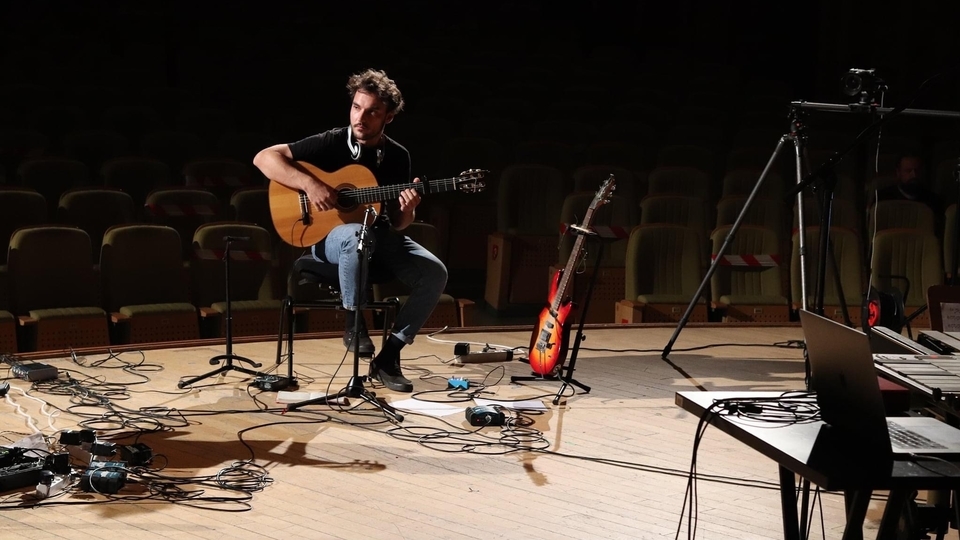
Interview with guitarist Radu Vâlcu
The Interplay International Tour kicked off this month in the United States with two concerts at the University of Southern California and University of California, Los Angeles. How did these first encounters with American audiences go?
We've just returned from the United States, Los Angeles and we're still basking in the atmosphere created there, which was very pleasant, largely thanks to the audience, who responded very well. We performed R.V.Q. pieces from our past albums on stage and towards the end, we invited the orchestras we've collaborated with to join us on stage. The audience's response exceeded our expectations and what delight us even more was the people's curiosity after the performance, we spent a lot of time talking about our music, our musical influences and what the music scene in Romania is like. It was an experience that gave us a lot of energy in return.
What was the basis for the collaboration with the classical guitar ensembles of the two universities and how did this musical encounter unfold?
Interplay stemmed from a desire to bring together two musical worlds with different approaches, contemporary jazz and classical music, and to explore how they might interact. Together with Mircea Gogoncea, who is a guitarist and also the professor of the guitar ensemble at UCLA, we developed this idea and I composed five original works specifically for this instrumental combination. The collaboration developed gradually through rehearsals and exchanges of ideas, during which we sought to find a common language between the two musical worlds. We wanted the guitar orchestras to actively participate in the musical discourse and it was very interesting to see how classically trained artists approached elements of improvisation.
As you mentioned, the tour program includes five original compositions written by you, which are being premiered as part of this project. The works were convinced specifically for the proposed instrumental line-up, which brings together a classical guitar orchestra and contemporary jazz quintet. How did this repertoire come about and what were your goals during the composition process?
Throughout history, in general, we've seen many interesting collaborations between jazz bands and symphony orchestras, or wind ensembles and jazz bands, or choirs and jazz bands, however, the pairing of a classical guitar orchestra and a jazz quintet is very rare, if not entirely unheard of combination, and that's precisely where the idea for the Interplay project came from. We felt there was untapped sonic potential and we wanted to discover it and bring it to the public's attention. In the composition process, I tried to make the most of the guitar orchestra's timbral possibilities and find as many ways as possible for it to interact with the quintet's instruments; above all, I wanted the orchestra to play an active role in this project and for the two ensembles to complement each other and build the musical narrative together.
An important part of the tour is the workshops held before each concert, which are dedicated to guitar students. What did you hope to convey to these young musicians through these sessions?
First and foremost, we wanted to offer them a different perspective on the instrument and on their potential as musicians. In general, classical training places a great deal of emphasis on fidelity to the score, whereas this type of collaboration brings improvisation and freedom of expression to the forefront. Together with Mircea Gogoncea, we tried to encourage them to experiment, step a little outside their comfort zone and view improvisation as a complement to their classical musical training. I believe it is very important for young musicians to be as curious as possible, to listen to as many genres as they can and not to limit themselves to a single way of understanding music.
After the end of the Interplay tour, what other projects do you have planned for the near future?
We'll be doing some concerts separate from the Interplay project. We'll also be performing in Bucharest around January and in April we'll have a very interesting project called Insight but we'll talk more about that as the date gets closer.
Translated by Cosmin Șerban,
University of Bucharest, Faculty of Foreign Languages and Literatures, MTTLC, year II
Corrected by Silvia Petrescu


