



> Interviews
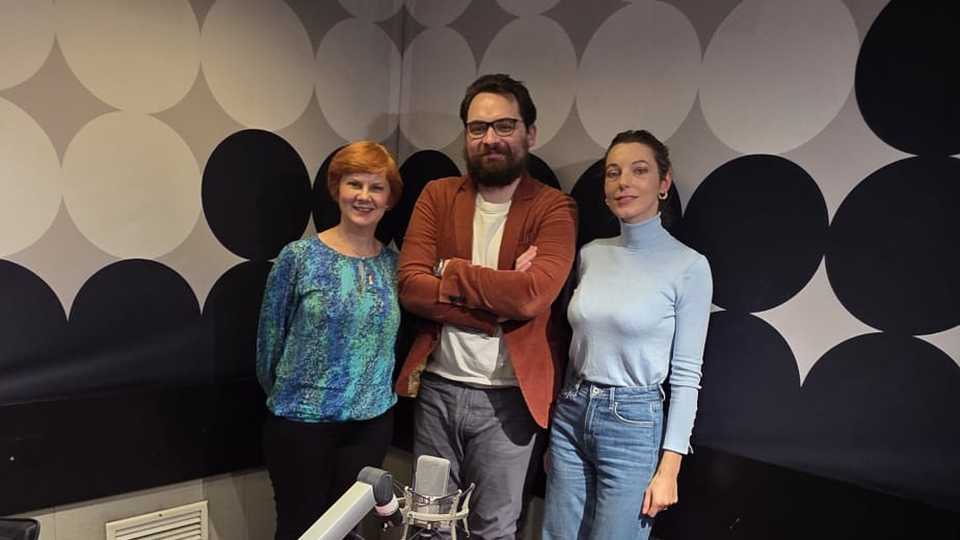
Interview with Axia Marinescu and Cristina Comandașu
The educational concerts in schools caravan organized by our radio station reached its end on November 11th, after multiple stops a day over the past two weeks. It was an intense schedule, carried out by pianist Axia Marinescu and organized by Cristina Comandașu, who are here with me, in the Radio România Muzical studio. Good evening.
Axia Marinescu: Good evening.
Cristina Comandașu: Good evening.
I think we can draw some conclusions after these two "harrowing" - I might venture to say - weeks, although I did not participate at all, but from what I gather it was a real tour de force, was it not?
Cristina Comandașu: That's right. In truth, the burden was on Axia Marinescu, whom I want to officially congratulate and thank very much, now that she has pulled off this tour de force, because doing three concerts a day, for a very special public, because, ultimately, for any of us, performing in front of children can serve as a litmus test, or, perhaps, it can be like performing in front of a den of lions. Axia passed the den of lions, as we called it, of this litmus test, which is very much alive and mirrors our society, and I am very thankful that she pulled off this tour de force for eight full days. I think I attended six of them, as I also had to take care of some things here at the office. My colleagues Andreea Kiseleff and Lucian Haralambie went with her, as coordinators. I am also very thankful to the technical team that accompanied her, composed of five people from Radio Romania, a real tour the force for everyone, one that I believe delivered outstanding results. I think it is time for Axia to tell us how it was for her.
Axia Marinescu: Yes, this was an extraordinary project for me too, one that I had been hoping to take part in for some time, and I am very grateful to both Radio România Muzical and to those that supported us and understood how important an initiative as this one is. I did not perceive these eight days as harrowing, I think that the biggest challenge for me was maintaining consistency in each performance, trying to play as well as possible every time, this is what I found most difficult. But, on the other side, there was always a different type of energy in the rooms I would play in, the children were different and of different ages, and I think it was easier for me to manage. I am very happy, I think we managed to carry out a wonderful initiative, and, besides this, it brought me a great deal of joy.
Exactly about this energy and eventually even about the mirroring of society I wanted to talk about: what effect did these hours spent listening to classical music have on the children, on the students? Because we are talking about young people that may have never made contact with classical music.
Cristina Comandașu: As far as I saw, the effect was extraordinary! The biggest lesson (for all of us adults, I think) is that children will behave in the way we raise them and that they are actually our mirrored image, and if we do not invest enough in them and do not expose them to the experiences they need to go through in life, they have no way of experiencing them. The teachers told us clearly: "Come again, because this is the only chance for these children to be exposed to this kind of cultural performance, as the parents do not have the time or they no longer feel like taking them to shows or play them classical music". Anyways, life is hard, we all know it… the teachers cannot take the students out of school and bring them to such educational events or maybe to a concert or anything else, because the bureaucracy is awful and many give up or it is simply too difficult, and then the children simply do not have the chance to enter a concert hall or a museum, to meet an author, or maybe even to see a good movie, something else than a commercial blockbuster. For almost every - and me and Axia approximate the number to be close to 4.000 - child we saw attend these 24 concerts, this was the first time listening to classical music live. We also saw something else: it was clear who has also taken part in past editions of the "Listen to 5 minutes of classical music" project, in its recorded version, which we have been doing in schools since 2014. This was a litmus test for us, as well as for the teachers and for the children themselves. Some recognized my voice because they knew it form "Listen to five minutes of classical music" and it was clear that they were listening more attentively or that they were at least in the know, but for the majority of them this was the first time they were ever seeing a pianist playing an instrument and hearing one of Enescu's pieces. I would like to congratulate Axia for the concept she brought, because when we were discussing before I said: "I mean, what do Mozart and Couperin have to do with Enescu?", and she answered: "He did influence them, after all" and only when I saw for the first time this type of educative concert performed, I understood that she is not only talking about Enescu, but rather takes a journey through the history of music, so that each child can choose something. We also saw that their taste has shifted from the classical-romantic direction to modern music, and I think we will play during this program the musical piece that had the most success. It is time we reveal what it is: Gymnopedies by Satie. But why do you think that is? From what I gather, it is very popular on all sorts of social media networks, on TikTok, on Instagram… so, from my point of view, we have to keep going. It is what the teachers asked of us, it is what we see the children need, seeing how they approached Axia after the performances and told her: "I really liked Mozart and Debussy, oh how much I liked it". So, the children really appreciated it, and I want to say that even in schools where the conditions were poor, you could see the children engaging at some point. We did have two essential conditions: the kids were not allowed to have their phones on them and the teachers had to present among the children, not only on the edges of the room, watching them condescendingly… I want to say that I was expecting it to be, how should I put it, much more disorderly, I mean, I expected reactions, children not paying attention and causing a disturbance. In some cases, we even had four to five hundred children crammed together in a gym, and the gyms were a challenge anyway for my colleagues handling the technical aspects, as they had to make sure that the sound could be heard clearly in a gigantic chasm. Somehow, all of these aspects came together, but I think Axia will tell you more.
Axia Marinescu: I would also add a third condition, that the teachers and school principals be open, because what I learned from this periplus is that there is no difference between the public and private systems when it comes to the availability to listen to classical music. We reached public schools in Berceni, and even Ferentari, where the principals were very open to classical music, and you can see it immediately in the students' attitudes, who already knew the "Listen to five minutes of classical music" program, and were also open to our performance, and I think this is what could use some work: the educational system should be more aware of the role classical music can have in society, in the development of future members of society. Besides the fact that we wished to introduce them to classical music, because many of them did indeed not know this concept, there were some that knew it and then of course the discussion acquired new facets, but I wanted very much to stir their curiosity and make them understand that every one of us has their own internal music we should simply listen to and eventually cultivate it, and I can say I succeeded.
Inside the Radio România Muzical studio, I was talking to Cristina Comandașu about the educational performances taking place under the aegis of our radio station at Radio România Muzical's initiative. So, for the past two weeks these educational performances have been taking place. We were talking about the feedback received from the children and about how they behaved, and I understand they behaved extremely well. I would also like to know what the teachers thought.
Cristina Comandașu: I regret not having my phone on me in order to read the teachers' opinions. All of them were delighted with the organization, the concept and how it all proceeded. I think this was a challenge for them as well, I mean wow, what were we going to do there. So, you see, here comes the contribution of the professional musician, and it was very good that it was a pianist of international caliber in front of the kids, as worth does not need much of a presentation, it shines on its own, even if Axia could not play a real piano, as we could not carry one in every school, it was logistically impossible, and we would have damaged the instrument by carrying it on so many stairs. Nevertheless, the emotion of live music, the explanations, the dialogue with the children, because we did not go there and just to each say something and leave, it was all interactive; we asked them questions, they had to guess the names of the songs, guess some instruments, tell us their opinions, as this is very important, and I even saw that in some schools, the children would open up kind of slowly, I mean, they couldn't believe: "Can I really say something?" and they were pushed to do so. So, for the teachers, the ones that wrote to me, they told me this is an outstanding tool, and they all think they need it, partly to lobby for classical music and for their colleagues, the other teachers, and for the parents and children, to show that what we are talking about is actually not just "something"; there is no textbook, no theoretical information, not even singing in a chorus, which some children may take part in, it is so much more: singing there, in their own classroom, their gym or their events hall. This is an experience we need and, how should I put it, I am actually determined to make a sort of public appeal to the entire community of musicians, to come together and continue to do these things because, without them, in 7 to 10 years from new no one will come in concert halls anymore. And this is not only a loss for musicians, because they will lose their jobs and the concert halls will close, but is also a loss for society. Society, without classical music and, in general, without culture is something we see in Matrix. We can see how it would look and think if we would like this. So, I still intend to raise funds, gather allies, so that projects like this one will reach as many schools in Romania as possible, because I realized now that they are absolutely necessary. And something else, I was reading this some days ago: today's society is much to oriented towards adults and too little towards children and young people. We always think solely through our own eyes, without considering whether things appear the same way to children, through their eyes. Children don't just need social media, mobile phones, and the like; they need to learn what is good for them; and culture is, without a doubt, good for them. Without it, we are merely walking bodies, and nothing more.
Axia Marinescu: Yes, and not only on a social level, but only on a personal level. Ultimately, classical music embodies universal values that, aside from the fact that they illustrate how humanity evolved over time, but they also make our life better; and the meaning of life is to live it beautifully, not aseptically. And what I find to be most interesting is that, as you were saying, Cristina, society may not look through the eyes of children as well, because we reached a point in which the primordial values are related to the financial aspect of life. Or, if children have the chance and opportunity to understand something besides this financial worth that had recently become a primordial value (in the past it was maybe a trading good, a bargaining chip), then society can turn to another direction and not in the one we are going right now, that is how it is.
An extremely general question, and I am sure we will not find the answer today, now, or in the following minutes, but how can we, as musicians inspire not only children or youngsters but also adults? Because society's values are not inspiring only children, but also adults. So, how could we go about passing on the importance and value of classical music?
Axia Marinescu: I am referring to exactly what we have also tried to achieve through these performances: I believe it is important to try to integrate classical music into a broader spectrum of cultural values, to provide context, for instance, for children; why did I think of such a repertoire; because I tried to illustrate the history of music and through some symbols that can also refer to some other factors in their lives and I think that when we manage to integrate music in other parts of the people's lives, then change can happen, because music itself addressed a plural society - in which we live, and not isolated - and then we can make certain connections easier, even for adults, and culture is, by definition, composed of analogies, ideas, and ideas are again universal, they are beautiful and true, regardless of the era, the social context, and the passing of time. I think this may be a solution. I am sure there are others as well.
Cristina Comandașu: Look, I will tell you now, unofficially, that this project was also followed on our Facebook page by the EBU Head of Music, Pascale Labrie, who sent me an email this afternoon, not only to congratulate me, but also to tell me that this is what we all have to do, because there are many discussion n the EBU about what European classical music public radio stations can do in order to advocate for classical music, and she asked how we managed to promote the radio station towards the children. And you know, I realized I will respond like this: these projects and everything Radio România Musical does are not about marketing, we are not trying to sell anything here, we are simply trying to promote the public well-being and I sought out specific approaches precisely where I personally sensed neuralgic points and I admit that my concern with the future is not only a motto, a matter of marketing, oh, let's do a project so we can better advertise ourselves. We are not trying to sell anything here; we are trying to be relevant for everyone's good. And when you no longer try to sell, but to simply be of use, I think that is when you become relevant. Of course it is much, 24 schools and 4000 kids who surely talked at home to two parents and four grandparents already rise the number we walked about, then we add the teachers and all their colleagues in the school. But this is not about numbers and neither about telling them to listen to Radio România Muzical or not. Axia chose to sometimes tell the "Also listen to Radio România Muzical". I did not tell them this. I told them to try to listen to classical music because it is good for them. I do not think there is a recipe, but there are things we can choose to do or not and is we choose to do something for everyone's good and not chase profits out of it, then probably something will change for the better. This is what I believe in, and I will probably keep doing things this way, as I have done over the years until now.
A short personal anecdote: I too listened to Radio România Muzical when I was a child, because I thought this is how it should be after all, and this is why I did not impose it on anyone else, not friends, not colleagues, no one from school, or my private life; because if someone wants to, they will listen. Where I was getting with all of this: obviously, we're not doing marketing, but that's not what this is about, but on a personal level, can we, as individuals, "change" the world through classical music?
Axia Marinescu: Obviously, or else it would make no sense. Obviously, yes. I think so, because, after all, art is made up of individualities, be it music, literature, or painting, this is what art means, it means creation, and creation is individual and I think that through contribution we can succeed. I do not have megalomaniacal expectations, I will not be the one to change mentalities, but by associating with people with similar mindsets, with entities that orientate in the same direction, I believe we can change something little by little, and that something may catch so that we will not fall into a deep pit where we cannot tell good apart from bad. I am sure that individual example can contribute through dialogue, which we tried to do with the children, not only show them some musical hits, but we also tried to talk with them, to let them speak, and then everyone can develop their perception of life, art and especially of music, as it was the topic.
Cristina Comandașu: I think anyone can change the world, and I also told the children this; everyone has their place in society, and we can change it for the better. We do so by treating others how we would like to be treated. This was a very good example because I also gave it when asking the children not to talk or not to make much of a commotion, so that we can respect each other, because this is what it is all about: what can we do in order to live more beautifully; and they can feel it, they would like to be bullied less, to fell respected, to see that they matter too, and that their desk mates do not have to hit them with books and so on. They live these things more intensely, all of these things, and maybe we did too when we were young, but now it is all very visible and violence in schools is a major problem… violence represents the immediate reaction to the lack of mechanisms through which society ought to control certain things and make our lives better. In reality, it is children who suffer because of the mistakes we adults make; that is why I believe that if each person simply does what they are supposed to do, then that is enough, absolutely enough. So, I encourage everyone to reflect on what their role is: what they can do well, both for themselves and for others, and, oh, then we would find ourselves in paradise.
And with this we can end our conversations today, I thank you very much for your presence in the Radio România Muzical studio, and congratulations for this project once more!
Translated by Cătălina Badea,
University of Bucharest, Faculty of Foreign Languages and Literatures, MTTLC, year I
Corrected by Silvia Petrescu


