



> Interviews
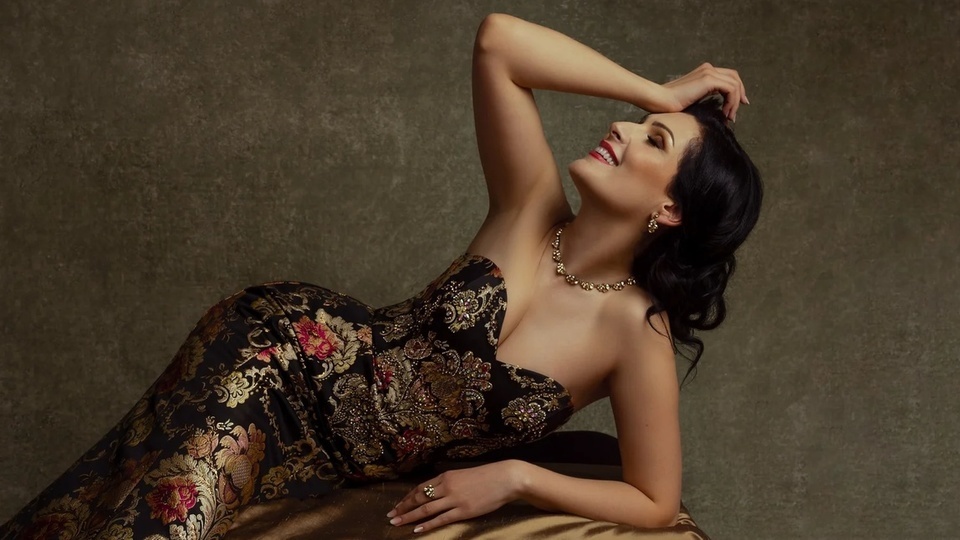
Interview with soprano Adela Zaharia
The renowned soprano Adela Zaharia gave two recitals in Constanța at the invitation of Ioan Holender, artistic director of the Cazino Music Festival. Before the first evening, on November 14th, 2026, we had a short chat with the Romanian artist, who is based in Germany. Adela Zaharia is one of the most important voices of the moment worldwide, with appearances on the greatest stages in the world.
Adela Zaharia, welcome back home to Romania! You're still recovering from a period of physical weakness. How are you feeling now? I was eagerly waiting to find out whether you'd be coming to Constanța for this recital.
I was also waiting with my breath held, waiting to see whether I could come or not, and I decided to come anyway. I decided to gamble, to take a bit of a risk and see what happens. Honestly, what I know right now is that after a bout of COVID, followed by tracheitis, it was very, very hard to come back. I was only allowed to start singing again this week, and, as on many other occasions, I'll see on stage how I get through the moment.
Unfortunately, this isn't an isolated case in the life of an opera singer. Where do you draw the line between what's required by contract and the health of your voice, and your personal health in general?
First of all, health is always the norm for me. In this case, with these recitals, I have to admit I made the decision a little more emotionally, not as rationally as I would on other occasions, because health must always come first. But at the same time, I feel personally a great sense of responsibility toward the theaters that hire me, and especially toward the audience, who make an effort to come. Especially when people write to me and tell me where they're traveling from and that they're waiting to see me. So I always do everything possible to be on stage, if it can be done.
An added pressure.
Exactly, exactly. It's an added pressure. But I'm glad that, after all these years on stage, I've come to know my body and my voice well enough to know when I have to draw the line. I know how hard I can push the limits, and how far. One detail, for example, is head voice. If I have my head voice, everything else can be worked out. If the head voice isn't there, then I know I have to cancel. If the head voice is there, the other components of the vocal instrument may give me a hard time, but I know I at least have a chance. I always want to make sure that nothing happens during the performance. So if I have any suspicion that I can't see the performance through to the end, I don't go on stage. Because I feel I owe a great deal to the audience.
You said that coming here was an emotional choice, and I assume an important factor is that the invitation came from Mr. Ioan Holender, artistic director of the Cazino Music Festival. How did you meet, and what importance has this great personality of the opera world had in your life?
Of course, I've known Ioan Holender for a very long time. He is a living legend, as they say. I think the first time I met him was when I was in the Opera Studio at the Komische Oper in Berlin, and he came to make a program for Servus TV, and so it happened that I was singing Pamina in the spectacle the program was about. He didn't even know there was a Romanian woman in the cast, but he found out. We also did a short interview. Mr. Holender is full of surprises. We did the interview in German, even though I didn't speak German at the time. And I think we met once more, but only in passing, in Düsseldorf, at the Deutsche Oper am Rhein, but then he came to make a program about a production of Samson et Dalila. At Operalia, unfortunately, he wasn't on the jury in exactly the year I went, 2017. And I could say our paths crossed briefly a few times, but the first important, proper meeting was last year, when I made my debut at the Wiener Staatsoper with Lucia di Lammermoor. And he came to see one of the performances. I didn't know, of course, but after the mad scene he was waiting for me in the dressing room. Because after the mad scene there was applause in front of the curtain, and when I came back, after the applause, he was already with me in my dressing room. We chatted for a bit and he was very, very, very kind, very warm. And then he made the proposal. The idea came to him right then, on the spot, and after he left the performance he even called Ana Maria, the director of the Casino in Constanța, and told her, "Look what I just heard!" So right then, the idea came to him, and I have to say that, coming from a person like him, who has lived so fully and met such incredible people, to have his appreciation, and for him to be so open and generous with his praise, means a great deal. It's a great, great honor for me. And of course I didn't know anything about this festival, especially considering it's the first edition, but when I learned it was organized by him and that he would be here, that was a guarantee of quality.
The event is, by the way, very welcome. We're just before the first recital evening, and I was curious how you find the acoustics of the Cazino hall in Constanța, at least now, at rehearsals, without an audience?
Yes, I have to wait and see how it is with an audience. Without one it's a little overacoustic; it has too much echo. But we'll see how it sounds with people in the hall. Although I, for one, honestly, always prefer a little echo over a "dry" hall, where you get no feedback while on stage.
The current season is very busy for you and brings extraordinary novelties. You were recently very well received in Paris, in the role of Ophélie in Ambroise Thomas's Hamlet. And two other moments of particular significance are coming in the 2026-2027 season: your appearances on the stage of the Teatro alla Scala in Milan. You'll make your debut there as Donna Anna in Mozart's Don Giovanni, and next year you'll sing, also there, Elvira in Bellini's I puritani. For you these aren't new roles, but what does it mean to sing them on the stage of the Teatro alla Scala?
Donna Anna is one of the roles I sing most often. It was a strategic decision to make many of my theater debuts with Donna Anna, because I don't like pressure, in general. I wanted to debut comfortably, calmly. For that reason at La Scala too, it seems ideal to me to begin with Donna Anna, to get used to the theater, the city, and the acoustics, and then to do the new production of I puritani. Of course, I was looking forward to my La Scala debut. It was basically the last important theater I wanted to tick off the list. Though I haven't really realized all this. Opera fans come and tell me, "Do you realize that less than 10 years after Operalia you've ticked them all off?" And I don't realize it, because I'm too caught up in the moment. But I was aware that La Scala was still left, and the fact that I've been entrusted with the I puritani production is a great, great, great honor and a great responsibility, because from what I've been told, I puritani hasn't been staged at La Scala in 50 years. I don't even want to know who sang it then.
Is there a singer who particularly impresses you in this role, the role of Elvira?
I really like to focus on the legends of opera, the emblematic voices. When I'm working on a role, if I need inspiration (and I do), I prefer to look to the great voices of the golden age. Caballé would be one of them, number one, I think, for me, when it comes to bel canto. I admire Mariella Devia and the technique she showed throughout her career, and the fresh voice with which she retired, at 70. So I mostly look for inspiration in those areas.
Photo credit: Oana Vedinaș
Translated by Gabriela Mara Puiu,
University of Bucharest, Faculty of Foreign Languages and Literatures, MTTLC, year I
Corrected by Silvia Petrescu


